
Your Income Is Not Your Wealth: A Practical Guide for High-Earning Households in Greater Seattle

There is a particular kind of financial stress that does not show up on a credit report or a pay stub. It belongs to households that, by every outward measure, are doing well. Two good careers. A combined income that puts them near the top of the earnings scale. A nice home in Tacoma, Puyallup, Bonney Lake, Bellevue or Seattle. And still, at the end of most months, there is surprisingly little left, and a quiet sense that one bad year could unravel a lot.
If that describes your household, you are not alone, and you are not doing anything unusual. You are experiencing the gap between income and wealth. This guide explains what that gap is, why it is so common among high earners in the Puget Sound region, how to measure where your household actually stands, and what you can do to build real financial strength without giving up a good life.
What is the difference between income and wealth?
Income is the money that flows into your household over a period of time: salary, bonuses, commissions, business distributions, rental income and investment income. It is usually measured per year or per month.
Wealth, often measured as net worth, is the value of everything you own minus everything you owe at a single point in time. It includes cash, investment accounts, retirement accounts, home equity, business equity and other assets, less mortgages, car loans, student loans and other debts.
Economists describe income as a flow and wealth as a stock. The distinction matters because a high flow does not automatically produce a large stock. Wealth grows only from the portion of income that is retained and put to work. Two households with identical incomes can end up with dramatically different net worth after twenty years, depending entirely on how much of that income they kept.
There is a third concept that matters just as much for day-to-day financial strength: liquidity. Liquidity is how quickly and cheaply you can turn an asset into spendable cash. Cash in a savings account is highly liquid. Home equity is not. Retirement accounts sit somewhere in between, because they are accessible but usually carry taxes and penalties if tapped early. A household can have substantial net worth and very little liquidity, and that combination is where much of the stress described above comes from.
A worked example: a $400,000 household in Washington State
Abstract definitions only go so far. Here is a realistic illustration of how a high income can leave very little margin.
The income
Consider a married couple in which each spouse earns $200,000 a year, for a combined gross income of $400,000. Each contributes 10% of salary to a 401(k), which removes $40,000 from taxable pay. They file jointly and take the 2026 standard deduction of $32,200.
Their federal taxable income is about $327,800. Under the 2026 federal brackets for married couples filing jointly, the tax works out as follows:
- 10% on the first $24,800
- 12% on income from $24,800 to $100,800
- 22% on income from $100,800 to $211,400
- 24% on income from $211,400 to $327,800
That totals roughly $63,868 in federal income tax.
Payroll taxes are separate. In 2026, the 6.2% Social Security tax applies to each worker's wages up to $184,500. The 1.45% Medicare tax applies to all wages, and an Additional Medicare Tax of 0.9% applies to combined wages above $250,000 for joint filers. For this couple, those payroll taxes total about $30,028.
Washington does not tax wage income for this household. (We walk through the state's tax picture in more detail in our video Moving To Washington? Here's The Truth About Taxes, Rain, and Cost Of Living.) The state enacted a 9.9% tax on income above $1 million in 2026, but it does not begin until January 1, 2028, and it would not apply at this income level.
Subtracting retirement contributions, federal income tax and payroll taxes from $400,000 leaves estimated take-home pay of about $266,104 a year, or about $22,175 a month. In practice, the figure will be somewhat lower once health insurance premiums and Washington payroll premiums for programs such as WA Cares and Paid Family and Medical Leave are deducted.
The spending
Now consider how a typical household at this income might spend $22,175 a month in the Greater Seattle area.
They purchased a $1,100,000 home with 20% down. Their $880,000 mortgage at an illustrative 7.0% fixed rate for 30 years carries a principal and interest payment of $5,855 a month. That rate is an assumption for illustration, not a lender quote, but it reflects current conditions: Freddie Mac's weekly survey of 30-year fixed mortgage rates averaged above 7% through much of November 2026.
Here is the full monthly picture:
| Expense | Monthly |
|---|---|
| Mortgage principal and interest | $5,855 |
| Property taxes and homeowners insurance | $1,100 |
| Childcare and tuition, two children | $3,800 |
| Two vehicle payments | $1,900 |
| Auto insurance, fuel and maintenance | $900 |
| Utilities, phones and internet | $900 |
| Student loan and other debt | $800 |
| Fixed obligations subtotal | $15,255 |
| Groceries and household | $2,200 |
| Health care out-of-pocket | $600 |
| Home maintenance reserve | $900 |
| Dining, travel and activities | $2,100 |
| Giving, gifts and miscellaneous | $700 |
| Total spending | $21,755 |
| Monthly margin | $420 |
Nothing on this list is extravagant for a household earning $400,000. There is no vacation home, boat or luxury car collection. It is simply what a comfortable life costs when each decision is made against the size of the paycheck.
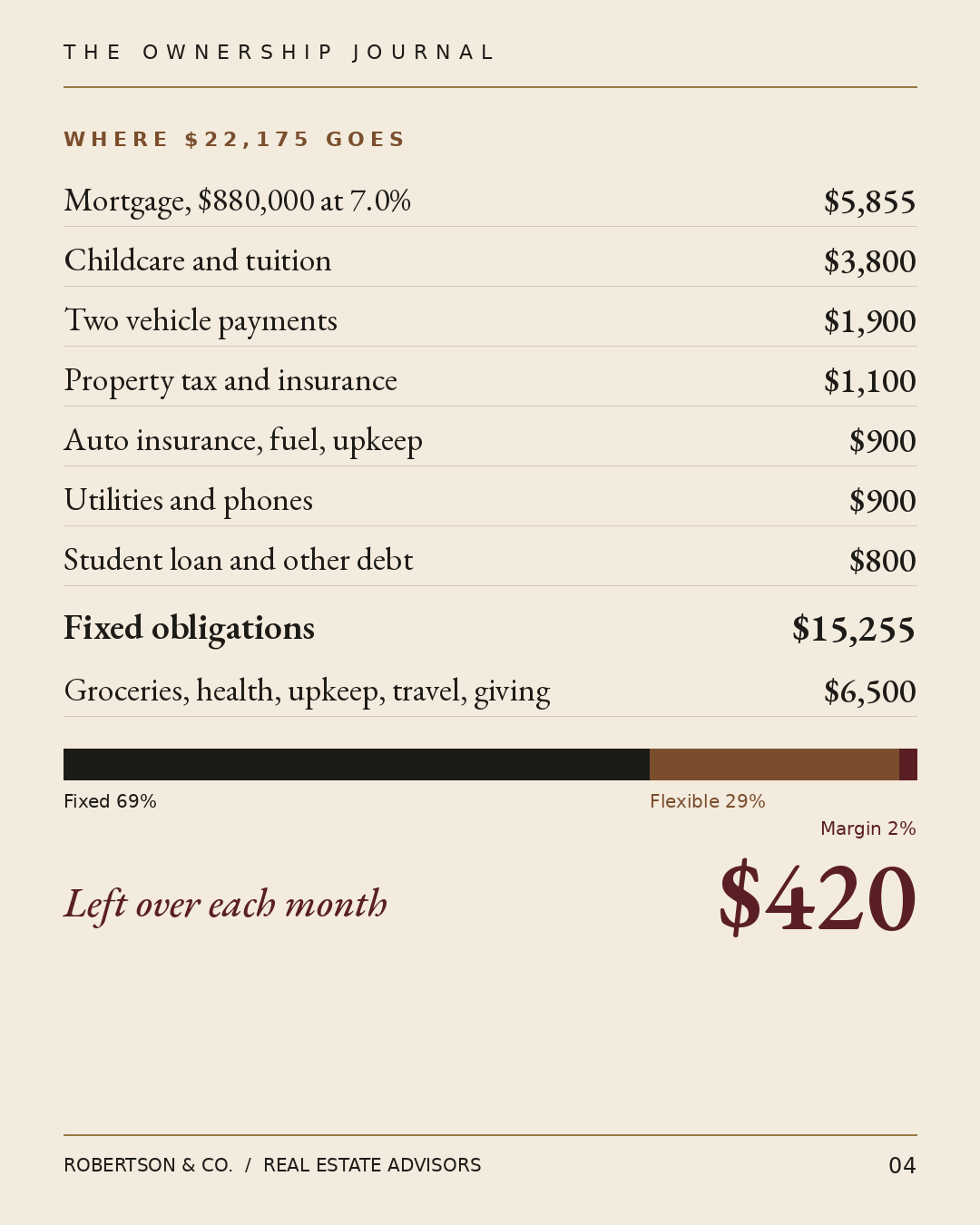
The result is a household that commits 69% of its take-home pay to fixed obligations and keeps less than 2% as discretionary savings beyond its 401(k) contributions.
The stress test
Now suppose one spouse loses a job, takes a career break, or leaves to start a business. On a single $200,000 salary, still contributing 10% to a 401(k), estimated take-home pay drops to about $11,977 a month.
The fixed obligations do not change. They are still $15,255. The household is short roughly $3,278 a month before buying groceries, filling prescriptions or paying for a single repair.
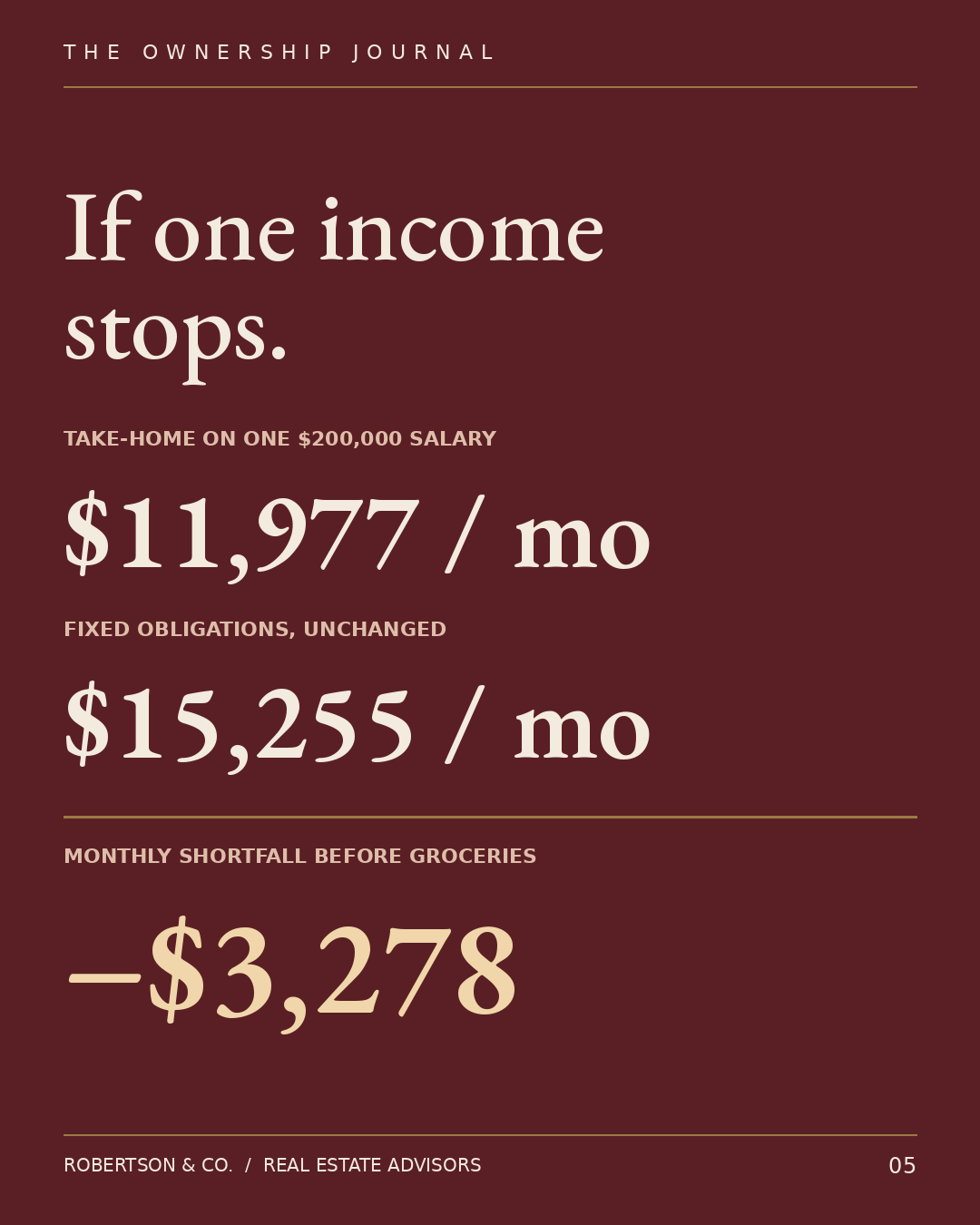
This is what it means to be one bad year away from trouble. The household is not irresponsible, and it may have significant net worth on paper. But its lifestyle has been built around a level of income that is not guaranteed.
Why high earners are especially vulnerable
It might seem that higher income should mean more cushion. In practice, several forces push high-earning households toward thin margins.
Fixed costs scale with income
At moderate incomes, overspending tends to happen in categories that can be cut quickly, such as dining out or shopping. At higher incomes, the largest costs are often contractual. Mortgages, car loans, private school tuition and childcare agreements cannot be reduced next month. A household that overspends through contracts has far less flexibility than one that overspends through habits.
Income is often less stable than it looks
Many high earners receive a meaningful share of compensation through bonuses, commissions, restricted stock units, profit distributions or self-employment income. These can vary substantially from year to year. When fixed costs are set during a strong year, a merely average year can create a shortfall. The Greater Seattle economy, with its concentration in technology and professional services, has shown repeatedly that compensation and employment in those sectors can shift quickly.
Housing costs in the Puget Sound region are high
Home prices across King County and much of Pierce County require large mortgages, and current interest rates make those mortgages expensive. A household that would have spent 20% of take-home pay on housing elsewhere may spend 30% or more here. Housing is the single largest fixed cost for most families, so it sets the tone for the entire budget. Property taxes vary meaningfully by city, which is why we ranked 10 Seattle suburbs with the lowest property taxes.
Lifestyle creep is gradual and social
Very few households decide to spend every dollar. Instead, each raise brings a slightly nicer car, a slightly larger home, a few more activities for the kids. Neighbors, colleagues and friends at similar income levels make those choices feel normal. Over a decade, a household can double its income and find that its savings rate has not improved at all.
Retirement contributions create a false sense of security
Contributing to a 401(k) or similar plan is valuable, and households should continue doing it. But because those contributions are automatic, many high earners treat them as their entire savings strategy. Retirement accounts are designed for retirement. Withdrawals before age 59 and a half are generally subject to income tax plus a 10% additional tax unless an exception applies. They are a poor substitute for accessible reserves.
Three numbers that matter more than your salary
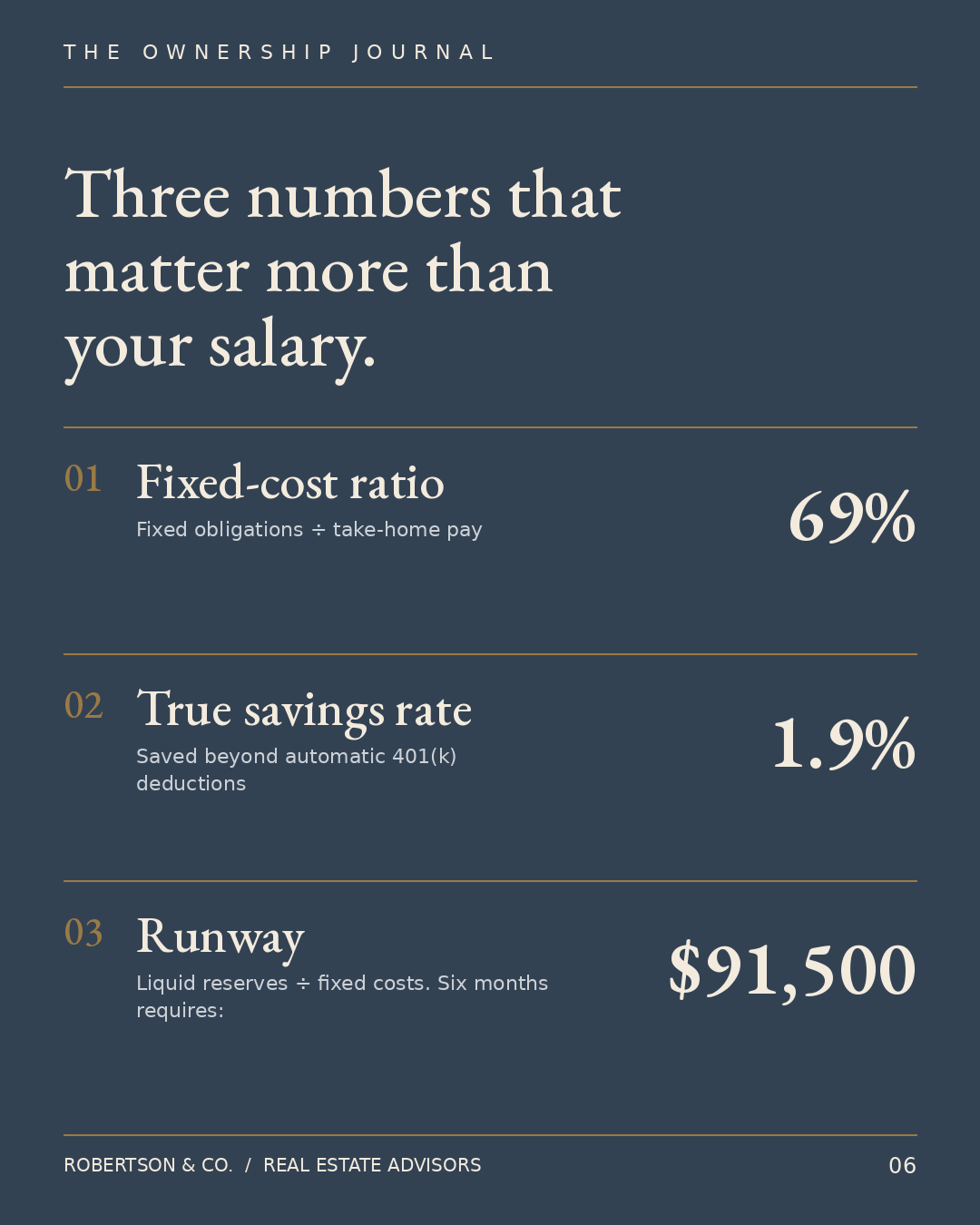
If income is a misleading measure of financial strength, what should you track instead? These three measures give a much clearer picture of where your household stands.
1. Your fixed-cost ratio
Definition: The share of monthly take-home pay committed to obligations you cannot meaningfully reduce within about thirty days.
How to calculate it: Add your mortgage or rent, property taxes and insurance, vehicle payments, childcare and tuition commitments, insurance premiums, utilities and required debt payments. Divide by your monthly take-home pay.
In the example: $15,255 divided by $22,175 equals about 69%.
How to interpret it: There is no official standard, but in our experience households tend to feel real flexibility when fixed costs are around half of take-home pay or less. Above roughly two-thirds, nearly every financial decision is constrained by obligations that were made in the past.
2. Your true savings rate
Definition: The share of take-home pay you save or invest beyond automatic payroll deductions such as 401(k) contributions.
How to calculate it: Track what goes into savings, brokerage accounts, business investment, or other wealth-building assets over a typical month, and divide by take-home pay.
In the example: $420 divided by $22,175 equals about 1.9%.
How to interpret it: This is the money that builds liquidity, funds opportunities and creates options during your working years. A household with a strong 401(k) but a near-zero true savings rate may be on track for retirement but has very little flexibility before then.
3. Your runway
Definition: The number of months your household could cover its fixed obligations from liquid reserves if income stopped.
How to calculate it: Add cash and readily accessible taxable investments, excluding retirement accounts and home equity. Divide by monthly fixed obligations.
In the example: Six months of runway would require about $91,500 in liquid reserves.
How to interpret it: Runway is the measure of time. It determines whether a job loss is an inconvenience or a crisis, and whether you can afford to make a deliberate decision rather than a forced one.
How to build margin without giving up a good life
The goal is not to live like a college student. A household earning a high income has worked hard for it and should enjoy it. The goal is to make sure the lifestyle is chosen rather than locked in, and that the household is building assets it can actually use.
Capture future raises before they become lifestyle
The least painful way to build margin is to hold your fixed costs steady while income grows. When you receive a raise, bonus or promotion, direct the increase into savings and investments before it is absorbed into spending. Most households do not miss money they never adjusted to.
Separate the lender's approval from your plan
A mortgage pre-approval tells you the maximum a lender is willing to lend based on income and debt ratios. It does not account for your career plans, your children's future costs, your desire to start a business or your need for reserves. Buying meaningfully below the approved amount is one of the most effective ways to protect margin for decades, because housing is usually the largest fixed cost a household carries.
For families in Tacoma, Puyallup and Bonney Lake, there is often a real trade-off between a larger home farther out and a smaller home closer to work. Run the full numbers, including commute costs and time, before assuming the bigger home is the better value. Our neighborhood guides for living in Puyallup and living in Tehaleh in Bonney Lake are a good place to start comparing.
Watch: What $1 million really buys you in the Seattle area, and what it costs to carry.
Keep vehicles longer
Vehicle payments are one of the largest and most overlooked drains on high-income budgets. Paying off a car and driving it for several more years frees up hundreds or thousands of dollars a month. Over a working life, that difference can amount to a substantial investment account.
Build runway on purpose
Choose a specific target, such as six months of fixed obligations, and automate monthly contributions until you reach it. Keep these reserves in high-yield savings, money market funds or similarly accessible accounts. Treat this money as a household asset with a defined purpose rather than a pool for the next large purchase.
Review your numbers together every quarter
A short quarterly review of your fixed-cost ratio, true savings rate and runway keeps both partners working from the same picture. Many financial disagreements in a marriage come less from the amount of money involved than from the absence of shared information about where it goes.
Think carefully before converting income into fixed costs
Before signing a new loan, lease or long-term commitment, ask a simple question: if our income dropped by a third next year, could we still carry this comfortably? If the answer is no, the purchase may still be worthwhile, but it deserves a much harder look.
Where home equity fits
Home equity deserves a specific mention, because for many households in the Puget Sound region it is the largest single asset they own.
Equity is real wealth. Over long periods, homeownership has been one of the most reliable ways for American families to build net worth, both through mortgage paydown and appreciation. But equity is illiquid. You cannot spend it without selling, borrowing against it or renting the property. Borrowing against a home to cover living expenses during a downturn is possible but risky, because it increases fixed costs at the very moment income has fallen, and lenders typically require income to qualify.
The practical lesson is that home equity should be one part of a balanced financial picture, alongside liquid reserves and diversified investments. A household with $500,000 in equity and two months of runway is more fragile than its net worth suggests.
Frequently asked questions
Is $400,000 a year considered wealthy?
A $400,000 household income is high by any national standard and places a household among the top earners in Washington State. But income alone does not make a household wealthy. Wealth depends on what the household owns, what it owes and how much of its income it keeps. A $400,000 household that spends nearly everything may have less financial security than a $200,000 household with low fixed costs and substantial reserves.
What percentage of take-home pay should go to fixed costs?
There is no universal rule. Many planners suggest keeping housing costs within a certain share of income, and in our experience households feel meaningfully more flexible when total fixed obligations are around half of take-home pay or less. The right target depends on income stability, family size, career plans and other goals.
Should I stop contributing to my 401(k) to build cash reserves?
Generally, no. Retirement contributions, especially those that capture an employer match, are valuable. Most households are better served by building reserves from new income, raises and reduced fixed costs while continuing retirement savings. A qualified financial planner can help you balance these priorities for your specific situation.
How much should a high-income household keep in emergency reserves?
A common guideline is three to six months of essential expenses. Households with variable income, a single earner, business ownership or high fixed costs often benefit from holding more. Measuring reserves against fixed obligations rather than total spending gives a more precise target.
Does Washington have a state income tax?
Washington does not currently tax wage income for most households. In 2026, the state enacted a 9.9% tax on individual income above $1 million, beginning with the 2028 tax year. Washington also has a separate tax on certain long-term capital gains and payroll premiums for programs such as WA Cares and Paid Family and Medical Leave. Tax rules change, so confirm current details with the Washington Department of Revenue or a tax professional.
Is it better to buy the most house I can afford in Greater Seattle?
Not necessarily. Buying at the top of your approval can maximize housing quality but often minimizes margin for everything else. Many households are better served by buying below their maximum approval and preserving flexibility for savings, career changes, business opportunities and family needs. The right answer depends on your full financial picture.
The long view
A high income is a tremendous advantage. It gives a household the capacity to build real wealth, support family, give generously and create options most people never have. But capacity is not the same as outcome. Only the income you keep becomes wealth, and only the wealth you can reach gives you freedom when you need it.
Income is what you earn. Wealth is what you keep, what you own and how long you can live without the next paycheck. If you have never calculated your fixed-cost ratio, true savings rate or runway, sit down with your household this week and run the numbers. The answers will tell you far more about your financial strength than your salary ever has.
If you are weighing a home purchase, a move or a sale in Tacoma, Puyallup, Bonney Lake or elsewhere in Greater Seattle and want to understand how the decision fits your household's full financial picture, we are always glad to help you run the numbers.
The figures in this article are illustrative estimates based on 2026 federal income tax brackets, the 2026 standard deduction for married couples filing jointly, the 2026 Social Security wage base and an illustrative 7.0% fixed mortgage rate. They exclude state payroll premiums, health insurance premiums and individual tax circumstances. This article is for educational purposes and is not individualized tax, legal or financial advice. Consult a qualified professional before making significant financial decisions.
Austin Robertson
Robertson & Co. Real Estate Advisors
For people building something worth keeping.
Categories
Recent Posts